 ARNAS
ARNASAn iPhone app to quit smoking
Quit smoking and stay quit. ARNAS walks you through the first month.
Every morning, a short read on what is happening in your body today and why today is hard. And when you want a cigarette, breathing that gets you through those five minutes.
- 30days of course
- 32milestones
- 30techniques
- 5breathing patterns
- 15currencies
- 7languages
The hardest part is not the first day
Resolve holds for about three days. Then the tiredness has piled up, the sharpest part is already behind you, and the relief you were promised still has not arrived. That is where most people light up again — not because it got harder, it was harder yesterday, but because nobody warned them the dip was normal, and they took it for failure.
ARNAS warns you on the morning it happens, not after.
Thirty days of the course — tap any day to read how it opens.
- Day 1 The loudest day. If it’s coming at you in waves — pull, then quiet, then pull again — know that this is exactly how it should be. This isn’t the plan falling apart. This is the plan.
- Day 2 Taste comes back. Something quiet and historic is happening in your body today: the last of the nicotine is leaving it. By tomorrow there will be as much of it in you as in someone who never smoked at all. Everything you feel from here on is no longer the substance. It’s the habit. And a habit, unlike a substance, can be retrained.
- Day 3 The top of the pass. Today is the summit. Day three is the peak of withdrawal: the craving can come more often and meaner than yesterday. You need to know that in advance, because not knowing breeds panic (“it’s getting worse, so it isn’t working!”) and knowing breeds calm. It is working. This is exactly what working looks like.
- Day 4 The day people give up. I’ll say it straight, because you deserve honesty: most slips happen in the first week, and its middle is the hardest bend. Not the first day, when resolve is still ringing. Not the tenth, when it’s already easier. Right now, when the peak seems passed, the tiredness has piled up, and the relief hasn’t arrived yet.
- Day 5 A truce at home. If you’ve snapped at someone who didn’t deserve it these past few days, you’re not the only one. Irritability is the most honest symptom of the rewiring: your brain is short on its usual stimulation and has turned sensitivity up to maximum for the time being. Everything grates, not because the world got worse, but because you no longer have the anaesthetic you numbed it with for years.
- Day 6 Taking back the night. If your nights have gone ragged lately, if you toss for ages, wake at four and see strange vivid dreams — this isn’t insomnia moving in. The rewiring has reached your sleep, and it’s temporary.
- Day 7 Seven days that are already yours. A week. Stop on that word for a second.
- Day 8 How a mine is built. There’s been no nicotine in you for almost a week. So why does your hand still go to your pocket after lunch?
- Day 9 Coffee without the smoke. Coffee and a cigarette are the oldest couple in a smoker’s life. They lived together so many years that your brain glued them into a single word: coffeeandacigarette. That’s why the first sip of the morning sets off the call — your body needs nothing, it’s simply missing the second half of the word.
- Day 10 The full stop after a meal. “Meal’s done, smoke’s on.” This loop has a peculiar trick: it disguises itself as the full stop in a sentence. A meal without a cigarette doesn’t seem to finish: you sit there waiting for something, as if the film had been cut before the credits. Recognise it? This isn’t hunger, and it isn’t even craving. It’s an unfinished script demanding its ending.
- Day 11 The sedative that never sedated. Today we take apart the biggest myth of the whole smoking life. It goes: “a cigarette takes the stress away.” You believe it not because you’re naive but because you felt it a thousand times: nerves at breaking point — a drag — relief. The sensation is real. The explanation is a lie.
- Day 12 Empty hands. Waiting. A queue. An ad before the video. Someone’s late and you got there early. Sound familiar, the way your hand crawls to your pocket in those empty minutes?
- Day 13 A minefield with music. I’ll put it plainly, as on day four: a night out with drinks is one of the most common settings for a slip. Not a hard day, not withdrawal — a fun evening. And it has an exact mechanism you need to know.
- Day 14 The building site in your chest. Two weeks. Time to show you what has been going on inside while you were fighting loops and coffee.
- Day 15 The danger of it getting easy. Easier, isn’t it? Waves less often, mornings without drama, yesterday’s walk a pleasure. The equator of the month, and it meets you with good weather.
- Day 16 The anatomy of “just one”. Here it is. The thought I’ve spent two days preparing you for. It comes to almost everyone in weeks two and three, it sounds grown-up and reasonable, and it looks like this: “I’ve managed it. I’m in control. One cigarette won’t change anything, I’ll smoke it and stop again.”
- Day 17 A conversation with the fridge. If you’ve been opening the fridge more often these past weeks, especially in the evening, especially for “something with the tea,” let’s talk about it honestly, without panic and without bans.
- Day 18 The money that didn’t burn. No physiology today and no traps: today is accounting, and it’s the pleasant kind.
- Day 19 Two words about you. Compare two sentences. “I’m quitting smoking” and “I don’t smoke.” They look like the same thing. There’s a chasm between them, and today is the day to cross it.
- Day 20 Armour made of three words. “Want one?” — “Oh come on, just one!” — “What, not even one? Not even to mark the occasion?” Familiar music. Today we’ll find the words for it, because hesitating in those moments is more dangerous than it looks.
- Day 21 The cleaning in full swing. Three weeks. Time to take the report from the building site we talked about on day fourteen.
- Day 22 Life without anaesthetic. Have your feelings got… louder? Joy brighter, anger sharper, sadness deeper, and all of it arriving whole, without warning. If so, today’s conversation is for you. If not, read it anyway: for many people it comes in week four.
- Day 23 If you stumble. This day is insurance. You may never need it, and that’s the best outcome. But insurance is issued before the fire, not after, so read it now while everything is fine, and let it lie there.
- Day 24 Signing for delivery. No new subjects today and no warnings: today is an inventory. For twenty-four days your body has quietly been giving back what smoke took for years. Let’s go down the list; you’ll be signing item by item, checking against yourself.
- Day 25 The power of example. Twenty-five days ago you were someone who wanted to quit smoking. Today you are someone who knows how it is done, from your own skin and in full detail: how to get through the peak, how to unstick coffee from a cigarette, how to answer “oh come on, just one.” That knowledge is currency. And today I’m going to suggest you spend some of it.
- Day 26 Scouting the future. For twenty-six days you fought the present, and you’ve all but won it. Today let’s lift our heads and look ahead, because there in the calendar stand dates that will test you. Better to meet them now, while they’re far off and harmless.
- Day 27 The toolbox. In three days the course ends, and I want you to see it clearly: what ends is the schedule, not the equipment. Everything that worked this month stays yours for good. Today we’ll lay out the toolbox and check every item.
- Day 28 Meeting the one who started. Twenty-eight days ago someone marked in this app why they were quitting smoking. They were anxious, not sure it would work, and they chose in a hurry, between waves of craving. Today you’re going to meet them. Open your “why” — it’s in the app, exactly where you left it — and reread it. Take your time, I’ll wait.
- Day 29 A letter through time. Yesterday you met yourself from the past. Today it’s the future’s turn.
- Day 30 Thirty days and a whole life. Thirty. Days. Without. Cigarettes.
What has already changed in your body
Thirty-two points of recovery, from twenty minutes to twenty years — the same ones the app shows. Tell it when you had your last cigarette.
- 20 minutes: Your heart eases off. Just 20 minutes have passed — and your pulse and blood pressure are already back to normal. Nicotine kept your vessels constricted and made your heart work overtime; now they’ve relaxed, and blood reaches your hands and feet freely again. For the first time in a long while, your heart is beating calmly.
- 1 hour: Easier on the heart. One hour smoke-free — and your blood flows more freely, while the strain on your heart keeps dropping. Every beat comes a little easier than an hour ago.
- 2 hours: Warm hands. Blood is reaching your fingertips and toes again — they’re warming up. You might feel a pull to smoke: that’s not weakness, it’s your body readjusting. A wave like that passes in a couple of minutes — you really can wait it out.
- 8 hours: Oxygen returns. In eight hours the carbon monoxide in your blood has halved, and oxygen has climbed almost back to normal. Cells all over your body, starved of air for months, are breathing fully again.
- 12 hours: Zero carbon monoxide. Carbon monoxide is completely gone from your blood — its oxygen level now matches a non-smoker’s. Your heart no longer has to pump polluted blood, and it feels the difference right away.
- 24 hours: First full day. A full day is behind you — and that’s a big deal. Your heart-attack risk has started to drop, and your lungs have begun a deep clean, clearing out mucus and tar built up over years. Your very first milestone is done.
- 2 days: Taste and smell. There’s no nicotine left in your body at all. The nerve endings it dulled are coming back to life — food tastes better and smells grow sharper. The world around you is literally gaining color.
- 3 days: Easy breathing. Your airways have relaxed and breathing feels noticeably freer. Withdrawal is peaking right now — but that’s exactly the turning point: the cravings only get weaker from here. The hardest part is almost behind you.
- 5 days: Past the danger zone. Days three to five are when the most people slip. You’ve made it all the way through this stretch. From here on, every new day comes easier than the last.
- 1 week: A whole week. The worst of withdrawal is behind you. Your body is already learning to live without nicotine — cravings come less often and don’t last as long. People who make it a week reach the finish far more often. You’re one of them.
- 10 days: Cravings ease off. The urge to smoke is now both rarer and shorter — your body no longer demands nicotine so insistently. Little by little, you’re relearning how to live without it.
- 2 weeks: Body in motion. Your blood is flowing more briskly and your lungs work better — moving around and climbing stairs has gotten easier. Inside your lungs, the cilia are growing back — tiny hairs that sweep the dirt out.
- 3 weeks: Lungs clean themselves. The cilia — those tiny hairs in your lungs — are actively growing back and sweeping out the tar that built up. If you suddenly start coughing, it’s not illness, it’s housekeeping: your lungs are getting rid of what they don’t need.
- 1 month: A clean month. Your cough and shortness of breath are easing, and thanks to better circulation your skin looks fresher. Your mind is clearer, your sleep deeper, your mood steadier. A whole month — that’s no longer an impulse, it’s a habit.
- 6 weeks: Deep clean underway. Your cough is peaking right now — and it will soon fade: your lungs have almost cleared the backlog inside. From here, breathing only gets easier.
- 2 months: A clear head. More energy, a steadier mood, better sleep and focus. Your brain has weaned off the nicotine rollercoaster and runs calmly, without the constant dips.
- 3 months: Second wind. Your circulation has strengthened, your lungs keep improving, and your heart-attack risk has dropped noticeably. Stamina and sleep are steadily better; for many, fertility rises in this period too.
- 100 days: A hundred days. Three digits on the counter. A hundred days ago this felt impossible — and now it’s simply your life. No longer an attempt to quit, but the way you live.
- 4 months: Endurance. Your heart and lungs have grown noticeably stronger. A long walk, the stairs, physical effort — it all comes easier than in the first weeks. Your body is getting back in shape.
- 5 months: A new normal. Not smoking no longer takes willpower — it’s simply how you live now. The journey began five months ago, and today it’s become ordinary life.
- 6 months: Lungs like new. The cilia have fully regrown — your lungs clean themselves again and fend off colds and infections far better. Less phlegm, less breathlessness. You’re halfway to a year.
- 200 days: Two hundred days. Two hundred days in a row, you’ve chosen yourself. This is a level most smokers only dream of — and for you it’s already behind you.
- 8 months: Deep breathing. Breathlessness and wheezing are almost gone, and your lungs work at nearly full capacity. That old “smoker’s cough” belongs to a past life.
- 9 months: A full breath. Your lungs have healed thoroughly: coughing and wheezing have nearly vanished, your breathing is deep, your energy noticeably higher. You can take a full breath — and feel the difference.
- 300 days: Three hundred days. Three hundred days of freedom. The one-year mark is on the horizon — you’re not far from closing the first big circle.
- 11 months: A year is almost here. Almost a full turn of the calendar — and not a single cigarette. You’re on the home stretch of your first year; the hardest part is long behind you.
- 1 year: A smoke-free year. A whole year! Your risk of coronary heart disease is now half that of a smoker. This is no longer a challenge or a pause — it’s your new life.
- 2 years: The heart grows stronger. Your heart-attack risk keeps falling, closing in on that of someone who never smoked. Your heart moves further and further from the danger line.
- 5 years: Lower stroke risk. Your stroke risk has dropped to almost that of a non-smoker. And your risk of cancer of the mouth, throat, esophagus and bladder has fallen by roughly half. Five years are working in your favor.
- 10 years: Lower lung-cancer risk. Your risk of dying from lung cancer is now about half that of a smoker. The risk of laryngeal and pancreatic cancer is dropping too. A decade of freedom is behind you.
- 15 years: A non-smoker’s heart. Your risk of heart disease now equals that of someone who never picked up a cigarette. Your body has rewritten this chapter completely.
- 20 years: Full circle. Your risk of dying from smoking-related causes has nearly matched that of people who never smoked. You didn’t just quit — you won back years of your life. The circle is complete.
How it works
Tell it when you stop
Today, a date ahead, or a day already behind you. A counter starts and a thirty-day programme starts with it.
Read two minutes each morning
A short piece written for that exact day: what is changing in your body right now, why today feels the way it does, and one small thing to do about it.
Open it when the urge comes
It takes you through slow breathing and waits with you: an urge peaks in three to five minutes and passes. Afterwards it asks what helped, and remembers it for the next time.
What it actually looks like
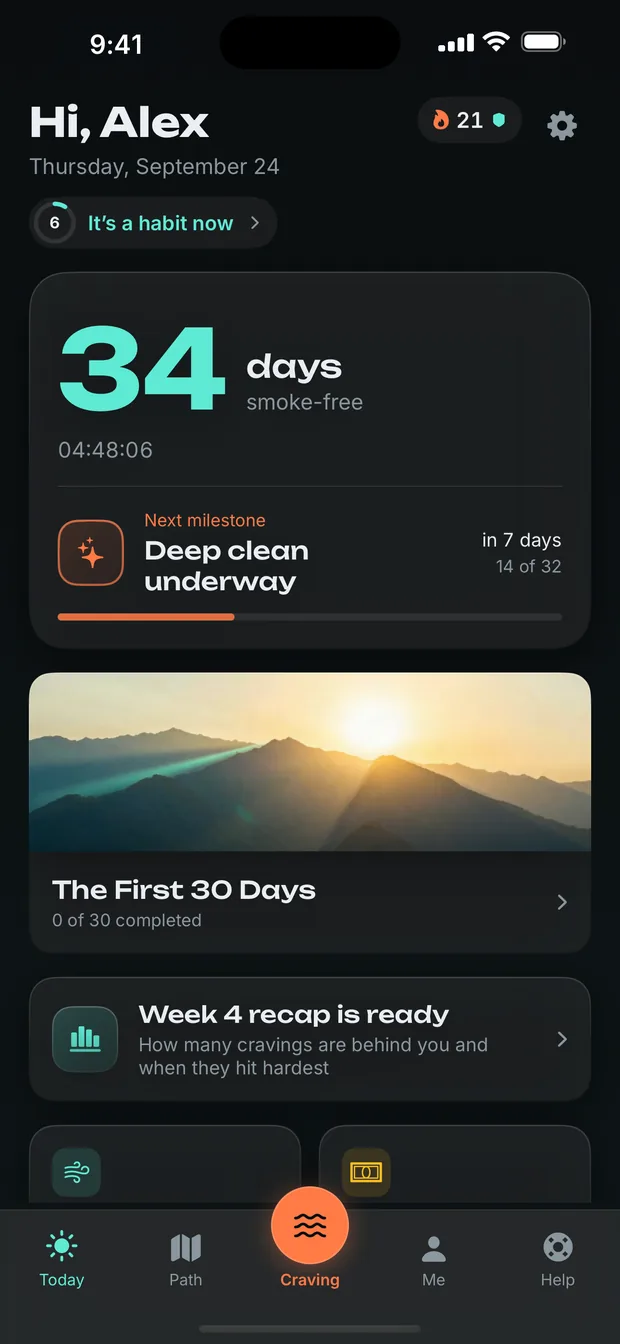
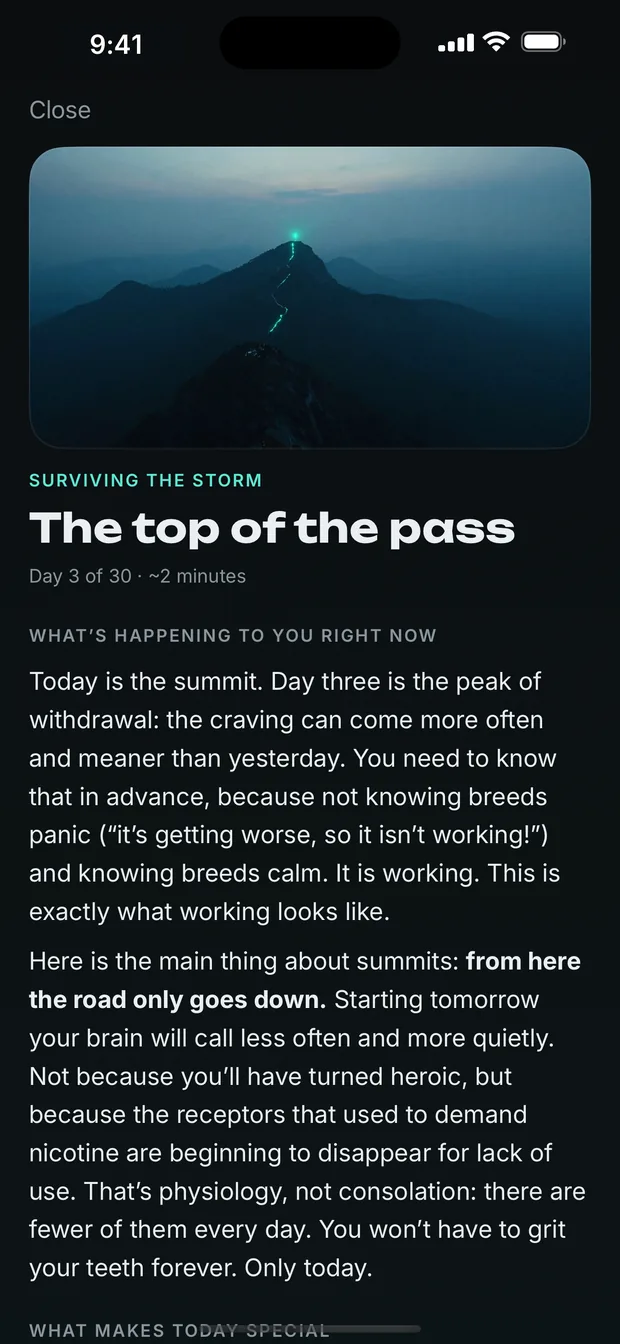
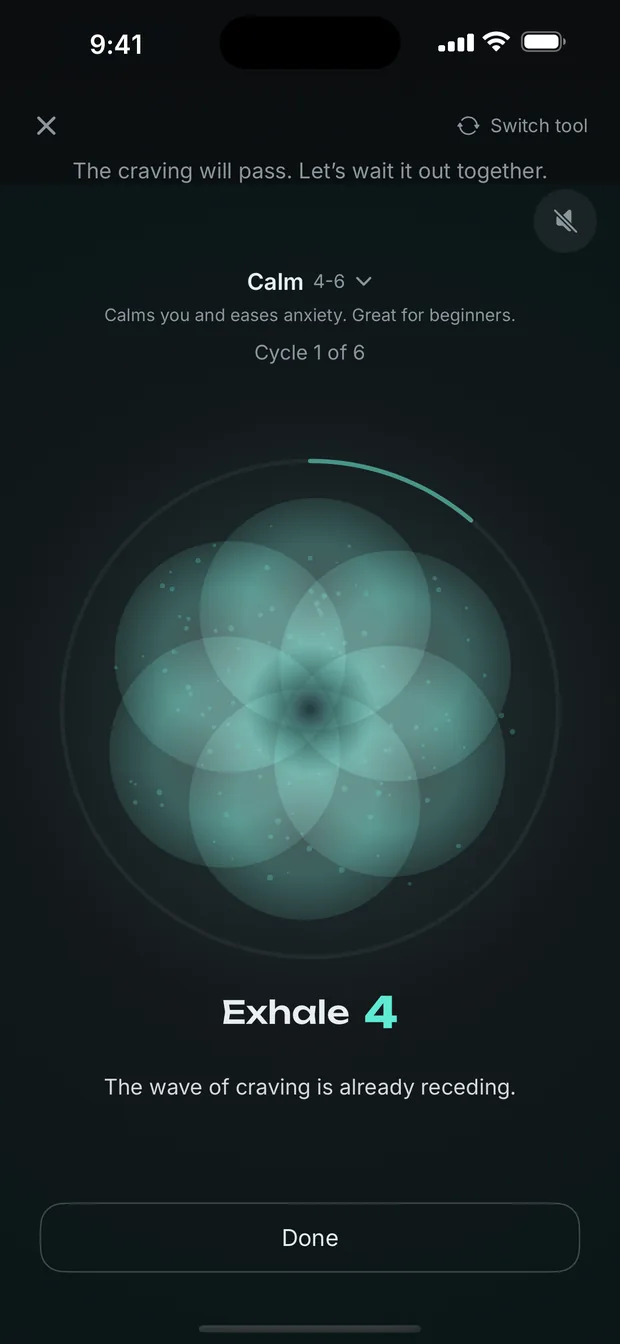
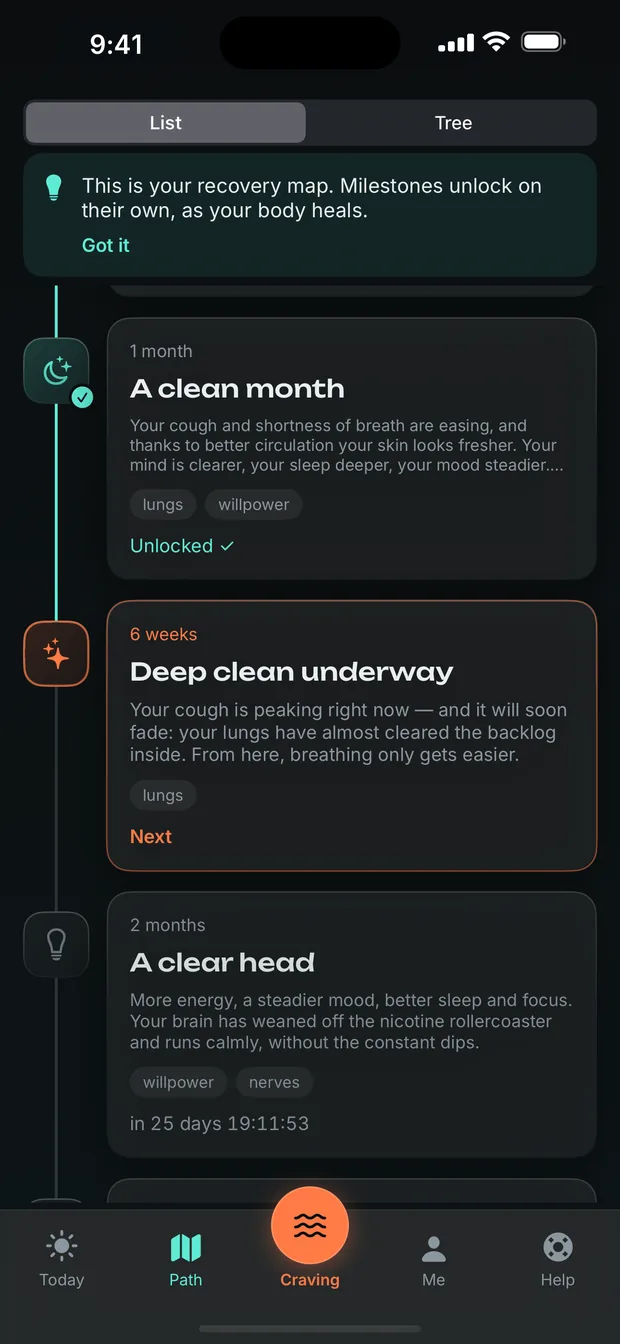
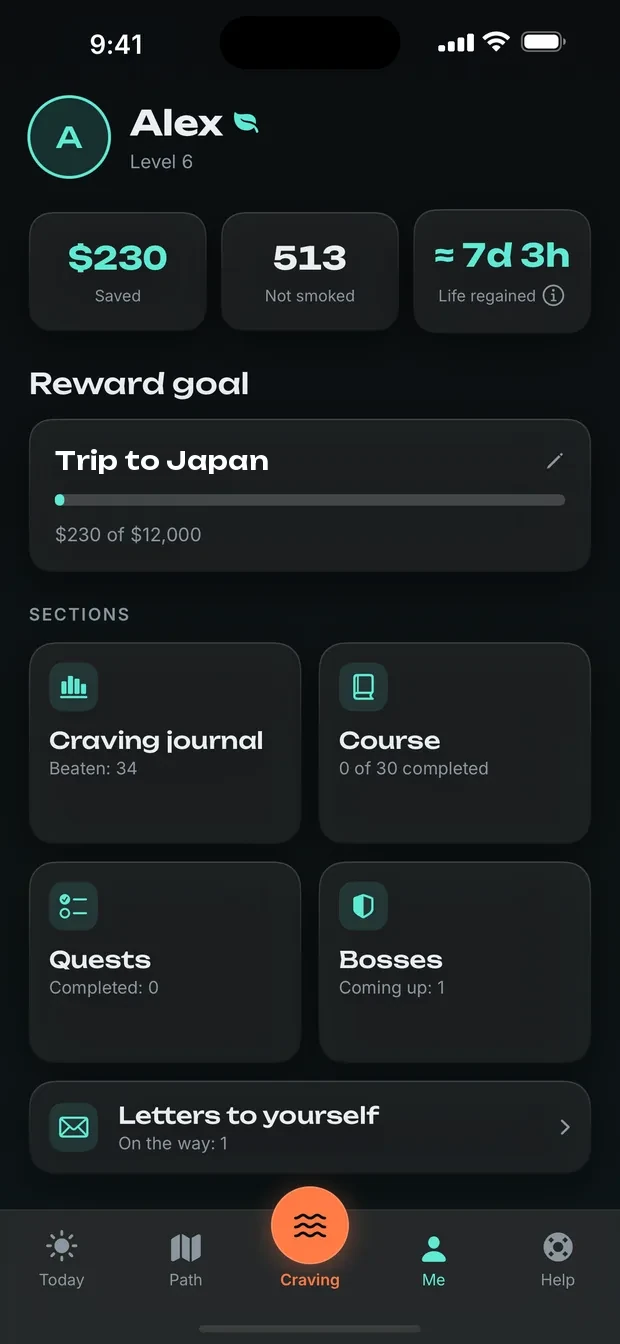
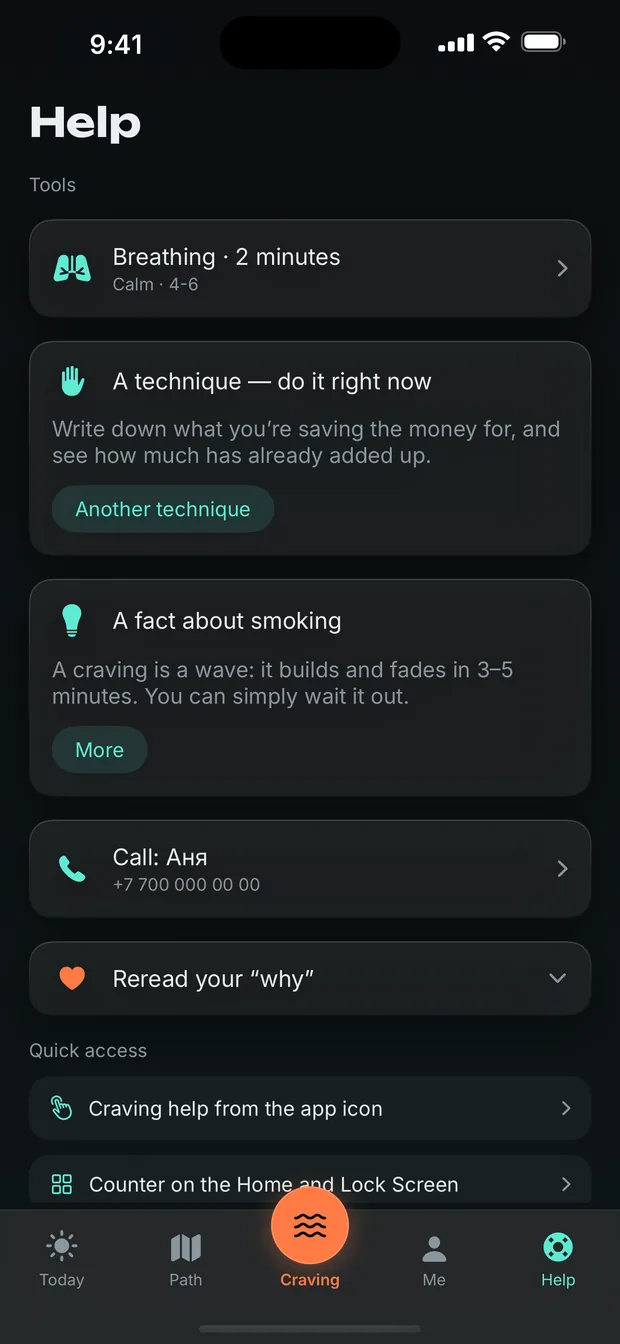
And everything around it
When it hits right now
One tap from any screen, from the widget or right from the app icon. Thirty techniques and five breathing patterns — 4-6, 4-4-4-4, 4-7-8 — with haptics and sound. One tap to call the person you chose in advance. And a journal that learns which tool actually works for you, then tells you.
For the days you can see coming
Eleven scenarios: a celebration table, stress at work, a party with drinks, meeting smoking friends, a hard morning, a long drive, a flight, an argument, a night shift, a deadline, a vacation. Make the plan while your head is cool, get advice on the day itself, log an honest outcome after.
Proof, not promises
Thirty-two milestones from twenty minutes to a year. Forty plain facts about what is repairing inside. Money in fifteen currencies, hours of life given back — and charts showing which trigger and which hour of the day are yours.
For the months after the thirty days
Fifteen levels, a skill tree of twenty-seven nodes across body, will and wallet, twenty-four daily quests you cannot fail, eight themes to unlock, letters to your future self that arrive in thirty days, six months or a year — and a recap of every week: when and why the urge hits hardest.
What you get back
Money and hours — the two things smoking takes quietly. Put in your own numbers.
- 0servers
- 0analytics
- 0ads
Nothing leaves your phone
No server. No analytics. No advertising. Not one third-party library. Your reasons, your journal and your letters stay on the device — we cannot read them. That is a fact about the code, not a promise about our intentions. How it works →
This page works the same way: no cookies, no counters, no third-party requests. Even the fonts are served from here.
Why this exists
I smoked for nearly twenty years and quit more times than I can count. I only added up the money late — it came to a small car. But the money was not the worst of it. Every day began with a thought about a cigarette and ended with a promise that tomorrow would be the last one.
When I quit for the last time, I looked for help in apps. All of them could do one thing: count days and congratulate me. Not one was any use in the minute when the urge really lands. And nowhere could I find a plain answer to the question that bothered me most — what is actually happening in my body right now, and why is today so hard.
So I started writing those answers for myself, one for each day. It turned out that writing them was how I quit. It worked. Then I finished the rest and made it into an app, because that was exactly what I had needed.
— the author of ARNAS
Thirty days. One at a time.
iPhone · seven languages · nothing leaves your phone.
Get it on the App Store